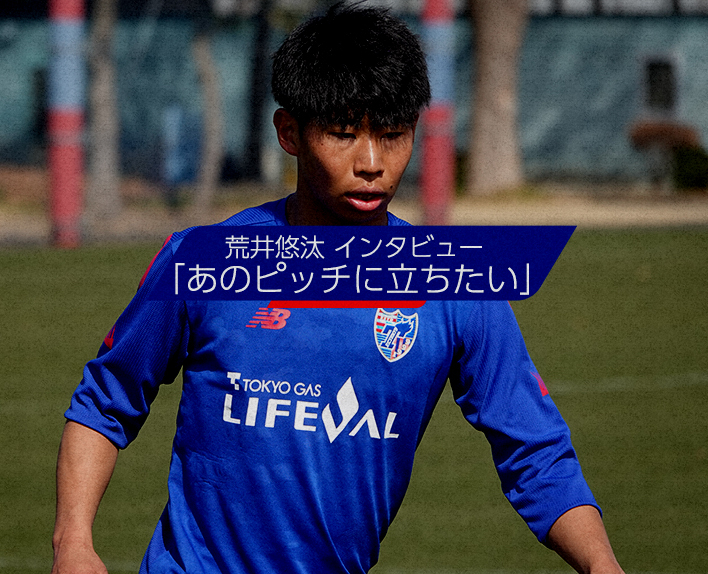


Q: What changes have you experienced since your official match debut in Tokyo as a high school student a year ago, compared to now as a professional?
A, When I was in high school, I practiced for about two weeks before participating in the Levain Cup, then returned to my high school club activities. Now, as a member of the Tokyo team, I practice with the team every day, so I think the environment has changed significantly.
Q. Do you feel any pressure due to the change in environment?
A, soccer has become my job, and from now on, it largely depends on myself, so I have come to feel that I must perform well. High school and professional levels are completely different, and I feel there are many struggles, such as the speed of pressure during training and matches. I do feel some impatience within myself, but right now, I am thinking about what I should do to win against players in the same position, and I am working on extra practice after training while talking with the coach. I want to quickly get used to the intensity of professional players' training and be able to express my own characteristics more.
Q. I believe you communicated with many players and staff during the camp. There was also a moment when you went to talk to player Nagatomo; wouldn't you say you gained a lot from that?
A, Tokyo football requires coordination with surrounding players, so we value communication with players on the same side. If there is a moment during play when the timing is off, we immediately discuss it, prioritizing not losing the ball, and consider whether it would have been better to open up to the side or drop back inside to position ourselves. If there is something we don't understand, we make sure to ask right away. I feel that my play still lacks forward momentum, so I am learning basic training from Nagatomo.
Q. There was a mention of communication with the full-back players, but is there anything you learn from watching players in the same position?
A, the players fighting in the top team smoothly pass the ball, making it interesting to watch. I want to play that kind of soccer when I join, so I review the opening match and study the movements of each player as well as the relationship between the fullbacks and wingers.
Q. Are there any other challenges in terms of play for player Arai?
A, when I was in high school, I often dribbled from my own half, but my playing style has changed, and I now use one-touch and two-touch passes more frequently. Since I didn't play that way in high school, I am struggling with it, and I feel this is my current challenge. I want to smoothly circulate the ball in my own half using one-touch and two-touch passes, and be able to dribble with my strengths inside the opponent's area.
Q, Speaking of your strengths, what do you think are the qualities that Arai has that other players cannot match?
I think I am good at one-on-one challenges on the side and crossing after cutting inside, so I want to share that with my teammates and make plays that lead to goals when the match starts.
Q. Are there any players you often communicate with and have a good relationship, including during your off time?
Recently, I have been spending a lot of time with Shuto ABE and Kuryu MATSUKI. They have been very kind to me, taking me out for meals and such. Since Matsuki is currently away for national team duties, I am with ABE almost every day.
Q: I often see you practicing independently with two other players, but I also have a strong impression that Arai is practicing one-on-one with the coach. Do you approach the coach yourself?
A, sometimes I go to call out myself, but recently Head Coach Anma has been conducting training instructed by Coach Albert PUIG ORTONEDA. Previously, Kei KOIZUMI, Abe, and I practiced pass and control every day with a set number of repetitions.
Q. In your personal practice, do you focus on the areas you feel you are lacking?
A, that's right. Recently, I have been practicing direct passes with Coach Yukihiko SATO. The grass on the professional grounds is very slippery, making the ball slide easily, so direct passes are difficult and hard to get used to. Therefore, I have asked Coach SATO to help me start with basic training and have been working on it.
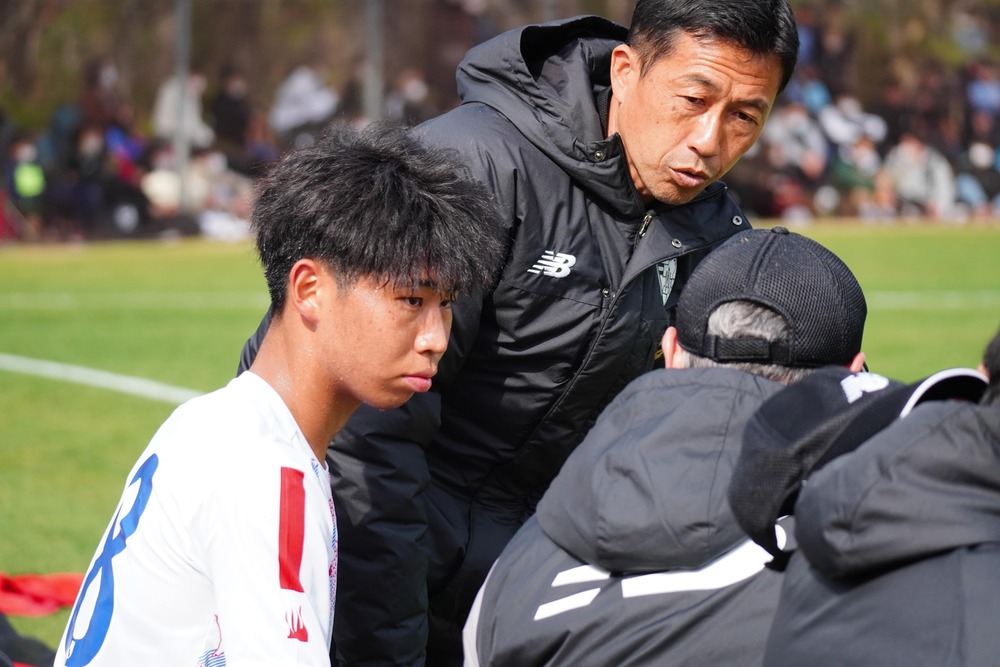
Yuta ARAI receiving instructions from Coach Albert PUIG ORTONEDA during a practice match
Q: On the player profile page of the homepage, you mentioned Kuryu MATSUKI as an influential player.
A, Matsuki has often talked to me since last season and has been looking out for me. I really feel the difficulty of performing well in the first year, so I respect Matsuki, who has played confidently since his first year last season, and I think I have to work hard too. There is a lot to learn from Matsuki, so I want to listen to him a lot and use it to help my own growth.
Q. What specifically have you learned from Matsuki?
<div>A. It's about the mental aspect. I used to think that during matches, when addressing seniors, you should add 'san' or 'kun' as honorifics, but Matsuki calls players without any honorifics, which shows a strong and consistent mindset and a strong mentality. Also, in scenes where he encourages teammates or gets fired up when fouled by opponents, I feel his courage and mental strength. These are areas where I lack, and I truly think it's amazing, so I want to strengthen my mentality.
Q, changing the topic a bit, you mentioned Mahrez as your favorite player in the player profile. Do you usually watch the Premier League?
I often watch Manchester City's matches. Their playing style is similar to Tokyo's, and Albert PUIG ORTONEDA also showed footage of Manchester City's games during last season's camp. I think he wants to play that kind of football, so I watch them. There is much to learn from overseas players, and I grew fond of Mahrez, who is also left-footed, by watching him score and assist. He is not a very physically strong player, but I hope to imitate his technique of slightly adjusting his shot with his left foot.
Q. Please tell us about your future vision.
A, first I want to achieve results in Tokyo, and then I would like to try playing soccer overseas. But of course, my top priority is to succeed in Tokyo.

Yuta ARAI training hard at Kodaira Ground
Q: The league season is starting, and the Levain Cup is also beginning. What kind of feelings do you want to approach it with?
A, as long as I get the opportunity to play, I have a strong desire to score goals and help the team win. I want to participate in matches in the Levain Cup, achieve results, and be involved in the league matches. First, when I get to play, I want to score goals and make an impression.
Q. From the opening match, the limit on the number of spectators was removed, and cheering with voice is now allowed. After watching the opening match, did your desire to play soccer in that atmosphere grow stronger?
A, When I was in elementary school, I cheered at the stadium with my relatives. I always wanted to stand on that pitch someday, so I have worked hard without forgetting self-practice and other efforts, and I want to make that dream come true. I think the atmosphere there is truly amazing, and it would be the best to be able to play in it. To play in that place, I believe the only way is to appeal through daily practice and practice matches, so I want to continue making efforts.
Q: The Levain Cup often highlights the participation of young players, but does Arai have any rivals outside of Tokyo players?
A, players Shio Fukuda and Ranhiro Hiroi. I became close with both of them when we were together in the high school selection team in our first year of high school. I have played for three years in high school with the desire to never lose to those two, and that feeling has not changed even now. I want to achieve better results than them.
Q. I think fans and supporters are also looking forward to watching Arai's play. Please share your enthusiasm.
A, When I play in a match, I will do my best to give my all and contribute to the team. Thank you for your support.