Q: First, please tell us about the 2021 season with Nagoya Grampus.
A, it was not that I couldn't participate in matches, and we won titles and were always near the top of the league standings. It was the early part of the season, but there was a time when we had a good rivalry with Kawasaki Frontale. We also competed in the ACL, and as a team, we were fulfilling. However, personally, it was not a season I was satisfied with, and while my appearances as a defensive midfielder increased, it is also true that I played with complex feelings—balancing personal emotions and the desire to fight for the team. I believe the reason I could no longer play in that position was because the results did not follow when I played as a center back. It was a year full of many thoughts.
Q, during your time at Cerezo Osaka, you played under coach LOTINA and showcased your solid defense while partnering with Matej JONJIC as a center-back. On the other hand, when you transferred to Grampus, it was a challenge knowing that there were rivals in the same position, such as Yuichi MARUYAMA and Shinnosuke NAKATANI.
During my time at Cerezo, I had a very fulfilling experience, but I wanted to challenge myself by changing my environment rather than just playing matches. At Grampus, I was strongly motivated to take a position from the two established regulars, but the main reason was prioritizing a change of environment. On top of that, I aimed to win the competition. At the start of the season, I was on the bench and occasionally played as a center back. I wasn’t too discouraged because I had transferred to an already established team, so I understood the situation. Then, when Maru (Maruyama) got injured, the situation changed, and I started playing more as a defensive midfielder rather than a center back. I had a similar experience during my time at Cerezo, and although I was able to play in matches, which might be considered a fortunate dilemma, I honestly had some internal struggles about that.
Q: Kimoto is a player who can perform at a high level as both a center-back and a defensive midfielder, but his true desire is to compete as a defender, isn't it?
A, I have a very strong feeling about that. Honestly, I feel my limits when playing as a defensive midfielder, but as a center back, I can show my strengths and still have room to grow. Considering my age, I want to compete as a center back from now on. I experienced playing as a center back during LOTINA's coaching era, and it greatly expanded my skill set. That period became the foundation of my career as a player.
Q: How did you feel when you received an offer from Tokyo?
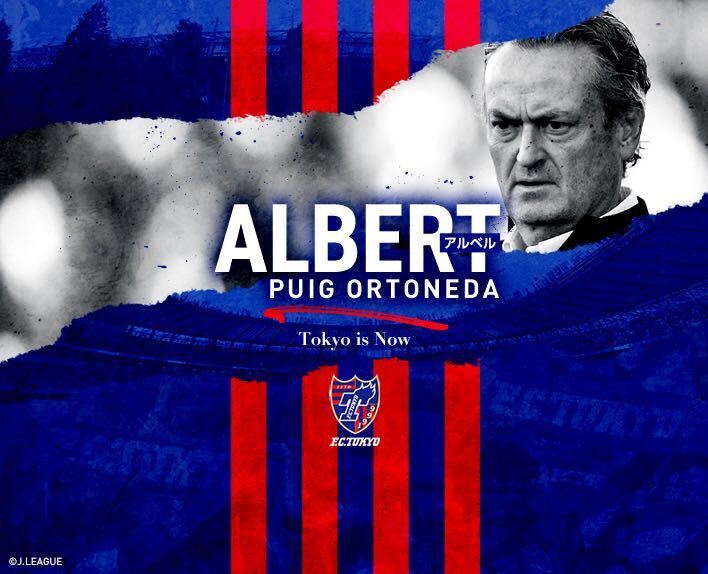
A, I never thought I would receive an offer, so I felt very grateful. With the new appointment of Albert PUIG ORTONEDA as the coach, I believe the style of play values positioning and ball control, so I thought it would be an environment where I could both challenge myself and grow. I have the desire to take on the challenge wholeheartedly once again here.
Q: You mentioned that you spoke with Coach Albert PUIG ORTONEDA once. What was your impression at that time?
A was a very cheerful and talkative person. Even though they were both foreign coaches, I felt that Coach LOTINA was different. He himself said, "He (Coach LOTINA) has a completely opposite personality (laughs)." I was very nervous, but I was also told, "Smile more" (laughs). As for the football aspect, I was told, "Since it's a style that values ball possession, I think you can grow even more."
Q: What are your impressions of Tokyo's attack and defense so far?
A, speaking of offense, the powerful attackers definitely make an impact. Of course, there are foreign players, but Japanese players like Kensuke NAGAI, who is a senior from Fukuoka University, also give a diverse impression. Speaking of defense, I think Masato MORISHIGE is the type of player whose style I aspire to, and there are many things I want to learn from him.
Q: What aspects of player Morishige are you concerned about as a fellow center-back?
A, first of all, in terms of building up the attack, he can deliver both long kicks and short passes. Defensively, he gives the impression of using his head very well to defend. I think this is a style worth learning from and aiming for on both fronts. Although I don't have a concrete image yet of actually forming a partnership, he is an excellent player, so I might often receive help from him, but I definitely want to form a good partnership.
Q: Player Morishige is a versatile type, and like player Kimoto, he has also had opportunities to play as an anchor. However, both of them give the impression of being mainstream types of center-backs in modern football.
A, that's right. Coach Albert PUIG ORTONEDA also told me, "Center backs will have more time handling the ball." In that sense, if the ball can be played out from both center backs, it will make it difficult for the opponents. Besides Morishige, the team also has young and good center backs, so I want to win the competition there.
Q: By the way, the name of your senior from university, player Nagai, came up. Are there any other players you are connected with?
A, there is absolutely no one like that (laughs).
Q, You're really diving into a zero-base situation, aren't you? (laughs)
A, Yes, that's part of the challenge too! (laughs) By the way, when I transferred to Nagoya Grampus, Yoichiro KAKITANI also moved from Cerezo, but I didn't have any close friends other than him. Personally, I think jumping into an unknown environment doesn't suit my personality. I'm not the type to actively start conversations, yet I transferred from Nagoya to Tokyo this time. It's contradictory, isn't it? (laughs).
Q: Player Kimoto has won cup titles during his time with Cerezo and Grampus, but he has not yet experienced winning the league. This is the same situation for Tokyo itself, but could you share your thoughts on the desire to conquer the league?
A, winning a title is always an irreplaceable and unforgettable experience in my football career. I have a very strong desire to experience a league title that I have not yet won. I definitely want to achieve that here in Tokyo.
Q: By the way, does player Kimoto watch overseas soccer or matches of other J clubs?
A, I don't watch overseas games that much. I've watched a lot of J.League matches since my student days. The players I liked were Yuki ABE and Ryota MORIWAKI of the Urawa Reds. After entering Fukuoka University, I started watching the Reds' soccer, which was then managed by Misha (Mihailo PETROVIC, current Hokkaido Consadole Sapporo coach), quite often. It was very offensive and interesting, so I liked it. MORIWAKI, although a defender, was very good at joining the attack. Since I was also a defender and liked attacking, I watched him. ABE was a player with high quality both as a defensive midfielder and center back, and like Morishige, I always watched him as a player whose style I wanted to emulate. Also, I respected his attitude of fighting for the team.
Q: I have lived in Shizuoka, Fukuoka during my university days, and then Osaka and Nagoya, and now I am starting my life in Tokyo for the first time. I've pretty much conquered all the major cities, haven't I? (laughs)
Ah, now that I think about it, that's true (laughs). Honestly, I only feel anxious about living in Tokyo. I like the slow-paced atmosphere of Shizuoka the most because it's the easiest to get used to, and even when I was in the city, I lived while feeling that. I'll be going to the capital of Japan, but I'm not very good with crowds, so I wonder how it will turn out (laughs).
Q: Due to the impact of COVID-19, there is a possibility that spectator restrictions will be eased in the 2022 season, and I believe many fans and supporters will return to Tokyo's home, Ajinomoto Stadium. Until now, it has been a stadium visited as an away team, but are there things you are looking forward to about playing at Ajinomoto?
I had heard before that the number of spectators in 2019 was amazing, and when I played as a member of Cerezo, the matches were held in front of a large crowd, creating a great atmosphere. The matches between Tokyo and Cerezo at Ajinomoto were teams led by Kenta HASEGAWA and LOTINA, so I have the impression that they were often tactically interesting battles. It was a match where both teams' characteristics came out, so I have very enjoyable memories. Next time, as the home team, I want to play in a match where Ajinomoto is filled to capacity as soon as possible.
Q: What aspects would you like the fans and supporters in Tokyo to see?
As a player, I think I am a modest type, but I have always had a strong desire to contribute to the team, so I want people to notice that even in a supporting role. In terms of play, my weapon is aerial battles. I am particularly good at contests in defense, so I want people to pay attention to that. On the other hand, heading in attack has been a challenge since 2017 as I haven't scored goals, so I want to improve on finishing. Morishige scores every season, so I want to learn from him in that regard. Also, although I couldn't often make passes from the back line during my time at Grampus, I hope you will watch for that as well.
Q, and in the context of your soccer career, it seems that there is significance in competing here as a center-back.
A, yes, I want to challenge myself as a center back, and on the contrary, I strongly feel that if I don't achieve results here, it will be the end. I want to proceed with a sense of urgency.
text by YUKI NISHIKAWA