

<Match Preview>
The journey of the 2022 season, which started on February 18, has reached its last two matches.
The final away game is against Nagoya Grampus. The team is led by Kenta HASEGAWA, who managed Tokyo for the last four seasons until last season. In the first half of the season, Tokyo's players were unable to score against the tactics of the coach, who is well-acquainted with them, resulting in a 0-0 draw.
The biggest threat to Tokyo is undoubtedly the presence of Kensuke NAGAI, who played in Tokyo until this summer. With his exceptional speed, goal-scoring instinct, and bright, beloved character, he was an important figure for Tokyo's fans and supporters. However, this time he will be aiming for Tokyo's goal as a key player for Nagoya. Like Coach HASEGAWA, NAGAI is also well-acquainted with Tokyo's players. How to stop him, who will be increasingly aggressive with the support of the home crowd, will be the key point of this match.
On the other hand, the players from Tokyo are also well aware of Nagai. How Masato MORISHIGE will confront him, and how Yasuki KIMOTO, who was nurtured as a junior in college, will stop Nagai's speed, will lead to an intense matchup, and ultimately, we hope for the Tokyo center-back duo to successfully contain Nagai.
The opponent's defense is led by Yuichi MARUYAMA, who is facing his former team. Following the four goals scored against Cerezo Osaka in the previous match, Coach Hasegawa is expected to implement thorough countermeasures against Tokyo's attack. Tokyo has shown fluctuations in build-up precision depending on the match, but when pressing from the front, they should calmly break the press. If the opponent is solidifying their defensive block with numbers in their own half, Tokyo aims to move the ball quickly to shake the opponent and seize any openings without hesitation.
This season, we have built a new Tokyo style on our journey with Coach Albert PUIG ORTONEDA. As a conclusion, we will bring home 3 points with the soccer of "traveling with the ball" (Coach Albert PUIG ORTONEDA).
[Interview with Coach Albert PUIG ORTONEDA]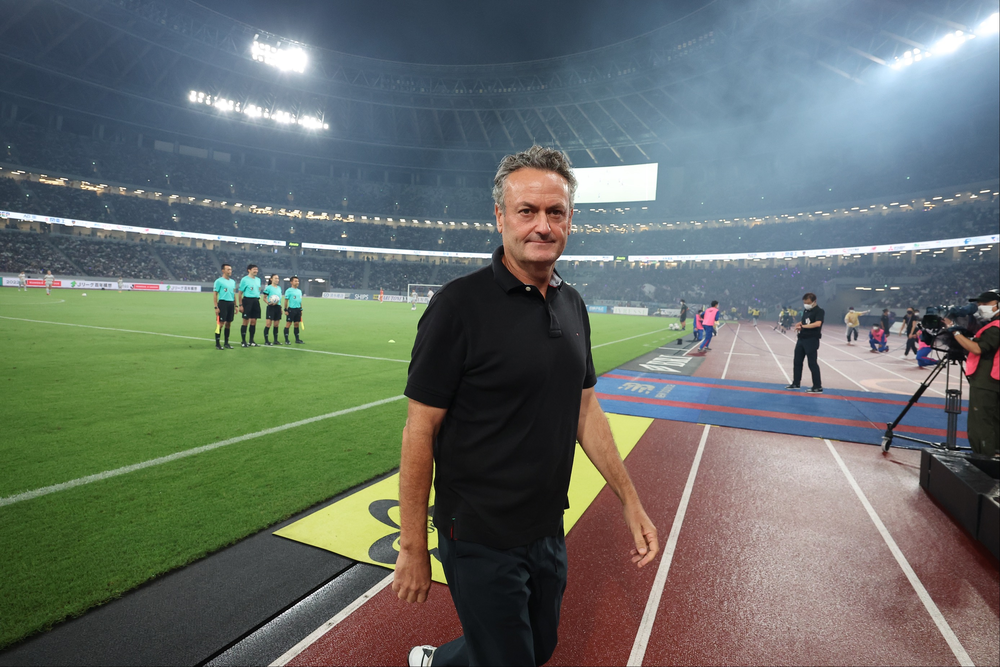
Q: There was a break in the league matches, but how is the team's condition?
A, we were able to engage in good training. I think it was a two-week period during which various things progressed smoothly. Just because things went well doesn't mean we can win the match, but there is a good feeling. I truly feel that the team is continuously growing steadily, and there is also a strong sense that the team is in good condition. However, each match is different, and the match results are influenced by various factors, so you really don't know until you actually play.
Q: At the beginning of the season, you mentioned that achieving about 50-60% with the new style would be good this season. What percentage do you think it is now?
A, I think we have reached about 60% of the level we are aiming for.
Q: What is the basis for that?
A, I feel that the current players have adapted well to this style. Naturally, I myself had to adapt to the characteristics of the players. As I mentioned in a previous opportunity, I never intended to do the same thing here as in Niigata. My aim was to do better work based on the players' characteristics. Of course, valuing possession of the ball is a non-negotiable part, but from there, I incorporated the team tactics based on the players' traits. As the first season of changing the style, I think the players have adapted well and reached a good level. The attacks in tight spaces are also steadily improving, and it is important to continue that growth going forward. However, there is still about 40% left to achieve, so there is still a long way to go. I want to continue making steady efforts in that area. Reaching the current level in about eight months is something worth appreciating. For example, Yokohama and Kawasaki, who are ranked above us, have been playing in this style for several years. We also need the same amount of time. I believe that as a club, by all the fans and supporters traveling together, we will grow into a club worthy of winning the championship. I don't think there are any other secrets.
Q: To fill the remaining 40%, you mentioned the sense of distance between players in the last practice. Is that something that will be necessary?
A, Yokohama excels at playing in tight spaces. One of our very important concepts is playing in tight spaces. In addition to that, making runs behind the defense is something we emphasize. This is because we want to leverage the fact that many of our second-row players are good at making forward runs. If, hypothetically, a player who is extremely skilled at close control joins next season, we would need to adapt our team tactics based on that player's characteristics. However, to achieve good combinations in tight spaces, time is definitely necessary.
Q: Is it important to maintain possession of the ball against teams that apply high pressure, such as Nagoya?
A. The reason we want to build up from the goalkeeper is that if we can successfully break through the opponent who applies high pressing from the front, space will open up behind them, increasing the chances to create opportunities. We are not connecting from the goalkeeper aiming for beautiful play. Teams that build up from the back against opponents who apply high pressing inherently face the risk of danger when the ball is lost. On the other hand, teams that apply high pressing take the risk of leaving large spaces behind them, hoping to create chances by winning the ball. I believe this is the kind of offensive and defensive battle between the two teams.
Q: I think Diego TABA was an important presence as a key foreign player this season. What are your thoughts on that?
I think he contributed in two ways. There are several reasons why his goal count decreased. One is that he had discomfort in his hip joint since the preseason and continued to play while enduring it, which was one factor. Additionally, if you look at the team's growth process, you can see that the team gradually improved and the number of chances increased. For example, Adailton is better at making runs into space. I think he had some chances from the beginning of the season. As the team grew and had more opportunities to press the opponent, players like Watanabe, Leandro, and Diego had more goal-scoring chances. Therefore, for various reasons, Diego's goal count decreased. Like Morishige, no one doubts that Diego is a very important player for Tokyo. As vice-captain, it was important that he is respected by all players, not just foreign players, due to his past performances. Additionally, there were several new foreign players who joined the team. Diego was the one who cooperated more than anyone else to help them adapt well to the team.
[Player Interview]
<Yasuki KIMOTO>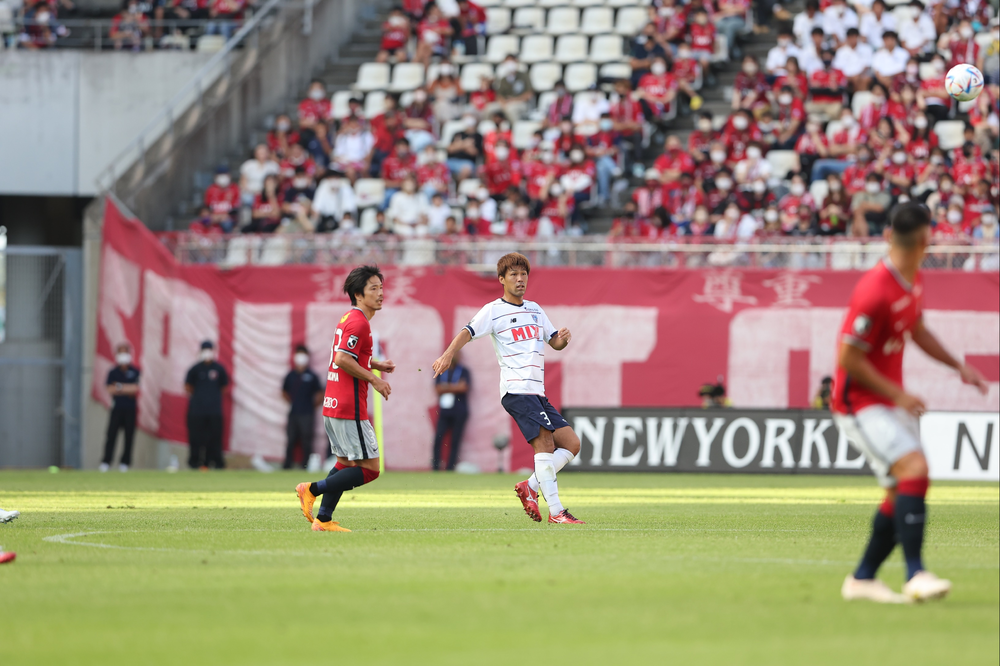
Q: What are your impressions of the match against your former team led by Kenta HASEGAWA?
A, my impression when we played against them was that everyone worked hard, and no one on the team slacked off. In terms of offense, I was impressed by their fast attacks that made use of the talents in the front line.
Q, I believe it is a match at Toyota Stadium, which holds a special significance.
A, it is a really great stadium and can hold a lot of people, so I think it creates a good atmosphere. I spent one year in Nagoya and experienced many good things, but also went through a lot of hardships, so in that sense I am grateful to the club. More than that, I have a strong desire not to lose and want to focus on competing to win.
Q: In a previous interview, I believe you mentioned that thanks to Kensuke NAGAI, you were able to enjoy playing soccer. Was his presence in Tokyo significant for you?
A, that's right. Although he is a senior from university, I am very grateful that he helped me blend into the team I just joined. He always tells me to enjoy playing soccer, and I believe that is the reason I am able to participate in matches now. I have feelings of gratitude like that, but I don't want to be defeated, and I want to do whatever I can to defend successfully.
Q: This time, you will be matched up against the opposing team's players. How do you feel about that?
A, the speed is the fastest in Japan, and since I cannot match that speed, I think it is important to take position first and not be beaten by speed.
Q: I think it is also important to consider how to maintain possession of the ball and build an attack against opponents who come with high pressing from the front.
A, I think Nagai will be the focal point up front, and they will apply pressure on us. We have the impression that we haven't been able to achieve good results against teams that press from the front, so we need to overcome that. It's not just about escaping with long balls; we've steadily built up the ability to connect from the back and use long balls when there's a risk, so I think it will be important to use both approaches appropriately in the Nagoya match. While doing that properly, I want to calmly connect from the back without fear and show what we've worked on throughout the year.
Q: There are two matches left this season, how do you reflect on your performance so far?
A, I have been starting in the league matches continuously, and this season has been the one with the most playing time in my career so far. I am having a fulfilling season. In these two matches, I want to aim for both good performance and results, making this the best season I have ever had.
Q: What kind of matches do you want to play while being in a position to aim for the ACL?
We can aim for 3rd place in Group A, but honestly, it also depends on other teams, so to aim for that, we have no choice but to win the next two matches. Without worrying too much about that, we want to focus on both the content and results of the remaining two games and finish the year on a good note.