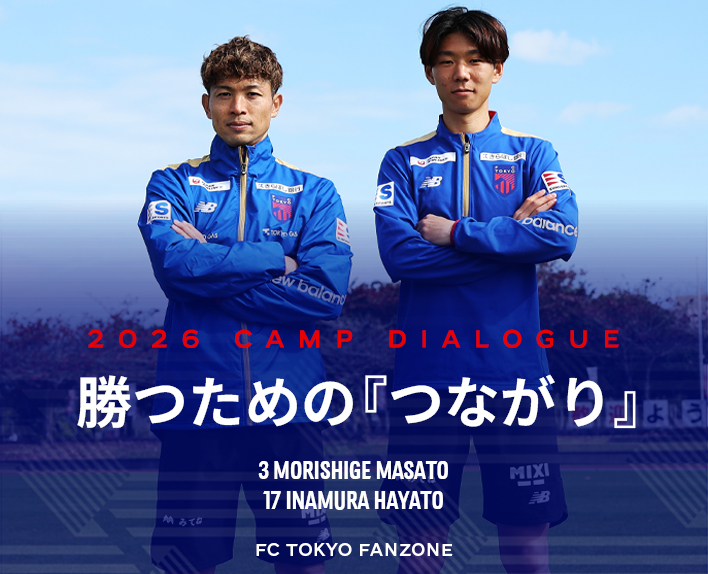


Coach Rikizo MATSUHASHI is entering his second season in charge. Building on last season's progress, he has set winning the Meiji Yasuda J1 Century Vision League as a clear goal. What style does he intend to adopt to approach this challenge? What are the important things that must be valued, and what issues must be addressed to achieve this?
Both players, who use build-up play as their weapon, talked about what is required to achieve true strength.

──What kind of changes are expected for the team in the 2026 season?
Masato MORISHIGE I think the 2025 season ultimately became a realistic way of competing. This season, with players like Ina (Hayato Inamura) and Hashiken (Kento HASHIMOTO) joining, we now have players who can hold the ball, which I believe will make the build-up smoother, and as a result, it will bring out the individual abilities of the forwards. Although there were some difficulties last season, I have a clear overall image now and think we have strengthened the missing pieces. From here, I believe Coach Riki (Rikizo MATSUHASHI)’s desired style of football will be refined and the team will be able to express it fully.
Hayato Inamura As a new player, I often talk about how "this team can become even stronger." The quality of the players is incredibly high, and everyone has something wonderful. However, it hasn't quite come together yet. This is something I felt both from the outside and after joining. Last season, after switching back to a four-back formation, the strength of our defense and the sharpness of our counterattacks are what make Tokyo great, and I believe we must not break that even with new players joining. On top of that, if we can bring out different aspects and play in a way that better utilizes the forwards, I think we will get closer to winning the championship.

──Since the start of this season, is there anything that Coach Matsuhashi has been emphasizing more?
Morishige emphasizes not only building up from the back with passes but also breaking free individually. It's not about escaping with passes; I often hear the phrase, "After one move outside, the scenery changes."
Inamura The coach often talks about the word "connection" during practice, and as Mori-kun (Masato MORISHIGE) said, "Not just passing, but I want the players to connect with each other even when breaking free individually," which he also mentioned during his time at Albirex Niigata. However, I think this is still a challenge for Tokyo. The sense of distance between players and the conscious effort to connect can help the ball circulate much better. I also believe it will make the most of the high quality of the players. When we hear "connection," we tend to focus on passing, but Riki-san is a coach who thinks about how to score goals. He is the kind of coach who is fine with scoring from a single long pass or connecting 20 passes. In that sense, I think he emphasizes that kind of connection.
──I certainly think that building such connections is indeed a challenge.
Inamura Everyone surprisingly doesn't talk much, and I felt that we should communicate more during practice, matches, and scrimmages. It's not about fighting, so I think it's okay to express opinions more and to make requests and accept them as well. I believe that also builds connections. It's important to speak up regardless of age, and I also felt that there should be more communication between staff and players, which I realized after actually joining. It's not about being close friends, but the more you talk, the deeper the understanding during play becomes. You can imagine what your teammates are thinking, and for that, everyday conversations are important. Everyone is kind, but I felt that many players quietly focus on their own work.
Morishige Certainly, that type might indeed be quite rare.
Inamura I felt that younger players should also speak up more. I believe that by talking more, a sense of unity will be created.

── This season, players, staff, and the club are united under the keyword "championship." What is necessary to achieve this?
Morishige What Ina just said is everything. To connect passes or to improve errors during the game, we have to talk and solve them on the spot, at each moment. You can't understand what anyone is thinking without communicating. Who wants to receive the ball in what way, who is good at what kind of pass, or who will definitely pass the ball if you're in a certain position. If you can see those connections, the passes will naturally circulate. Then, if you talk regularly, you can move smoothly without having to say everything out loud, and a mutual understanding will emerge. We have to keep building those relationships. Ultimately, the finishing part requires quality, but this is very important for playing this style of football, and to some extent, we can build up to that. Everyone has to work on that process together. We must not end up making a major change in direction midway like last season when results didn't come, and I think it depends on how much we can pursue that.
Inamura I have been watching Tokyo for a long time, and I thought they were a team with ups and downs. When they are really strong, no matter who the opponent is, the game becomes Tokyo's and they win. On the other hand, there have been many matches where you wonder what happened today. If they don't eliminate those kinds of games, there will be more wasted matches. Last season, Kashima Antlers, when they felt they were not in good form during a game, adopted a style of decisively doing what they could and steadily accumulating victories. That kind of approach is important, and I think it comes from communication. Of course, there is an ideal style of soccer, and as the players pursue their ideal play, there will be times when they need to make compromises. What matters is how to act for the sake of winning and for the team, so even though I am a new player, I want to take on that responsibility as well.
── I believe many fans and supporters have high expectations for this season. Lastly, please share your enthusiasm with us.
Morishige believes the players are all set, so now it's just about delivering results that will please the spectators. We want to win firmly and increase the number of matches where everyone can leave with a smile.
Inamura I will keep winning because I want to look up at Ajinomoto Stadium from the pitch, where about 40,000 people used to gather and get excited when I was in junior high school. So, I will keep winning no matter what.
(Honorifics omitted in the text)
Text by Kohei Baba (Freelance Writer)